Introduction

Digital Literacy Class: We are going to learn about so many incredible ways to be creative, collaborative, and to communicate. We will focus on computer skills and applications. Some topics you already know about, and you will know better, and other topics and applications will be new to you! Either way, we will work together to find the ones you are able to use best. This class consists of Project-Based-Learning. You will be given plenty of time to learn the skills and applications that you will use for a lifetime. I hope you enjoy the material we will cover. - Mr. S

Monday, April 4, 2022

Personal Data Visualization Digital Art Project

BACKGROUND
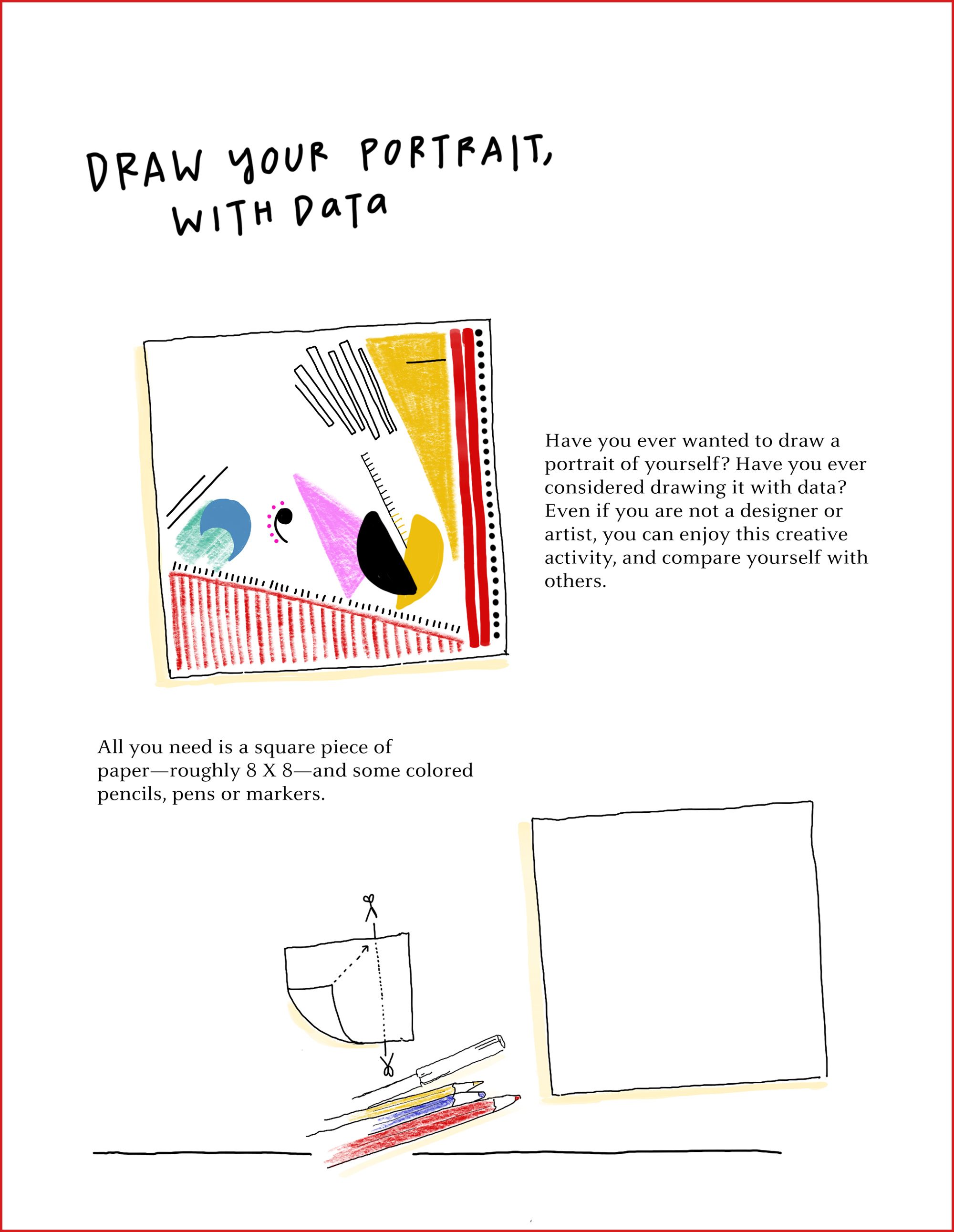
"Designer Giorgia Lupi wants to change the way we think about data — far from being cold facts and numbers, it can be warm and often flawed. Follow her step-by-step instructions to generate a data-driven perspective on the person you know best: you."
- Freitas, J., & About the authorJames Freitas is a writer from Massachusetts. (2017, October 02). How to draw your own selfie - using your personal data. Retrieved April 20, 2021, from https://ideas.ted.com/how-to-draw-your-own-selfie-using-your-personal-data/

OVERVIEW

The following project will help you understand how data can be used to create visualizations that help others understand it more easily. Many examples exist in our world, and many careers are increasingly relying on these types of visualizations to make sense of the vast amounts of data that are generated by almost everything we do. From our shopping and personal habits to the large amounts of data created by almost every field of study, it is sometimes easy to become "lost" in the numbers and stacks of random tables that the data is organized into.

"Remember that data, like us, is imperfect. “It’s time to leave behind any presumption of absolute control and universal truth,” says Lupi. Since we get our data from humans; it’s riddled with human error and tainted by biases. We should embrace these imperfections, just as we embrace imperfections in ourselves and others. These portraits are only the start of forming a new relationship with your data. Once you feel more connected to it, you’ll see it differently. We must treat data “as the beginning of the conversation,” Lupi says, “and not the end.”" - IDEAS.TED.COM (article references above)

Please spend some time tonight watching the following video about this project:
https://www.ted.com/talks/giorgia_lupi_how_we_can_find_ourselves_in_data

(❗️) PROJECT / ASSIGNMENT
Students will create an original art piece using skills and tools (SKETCH.IO) from the last lesson. Students will open the following Data Selfie Digital Art Project Google Slides (Click Here) and follow all the directions to complete their personal data portrait. Once completed students will need to upload their final project to their Google Drive and SHARE it with Mr. S (harvey.scribner@techfreire.org) for credit. Students should also post this project to the main page of their Student Digital Portfolio (Quarter 1 Project).

LEARNING OBJECTIVES
After this lesson students will be able to:
  define digital art
  discuss the history of digital art
  explain how digital art is used today
  create some basic examples of digital art3.5K views

CURRICULUM STANDARDS (PA)
CCSS.ELA-Literacy.RH.11-12.4: Determine the meaning of words and phrases as they are used in a text, including analyzing how an author uses and refines the meaning of a key term over the course of a text (e.g., how Madison defines faction in Federalist No. 10).

CCSS.ELA-Literacy.RH.11-12.5: Analyze in detail how a complex primary source is structured, including how key sentences, paragraphs, and larger portions of the text contribute to the whole.

CCSS.ELA-Literacy.RH.11-12.7: Integrate and evaluate multiple sources of information presented in diverse formats and media (e.g., visually, quantitatively, as well as in words) in order to address a question or solve a problem.

MATERIALS
Computers with Internet Access and Sketchpad.IO or similar application
A photo of digital art

REFERENCES
https://study.com/academy/lesson/digital-art-lesson-plan.html
https://sites.google.com/a/greenvilleschools.us/millerdigitalarts/art-1
https://www.ted.com/talks/giorgia_lupi_how_we_can_find_ourselves_in_data
https://ideas.ted.com/how-to-draw-your-own-selfie-using-your-personal-data/


Friday, April 1, 2022

Digital Art Introduction

OVERVIEW
In today's class, students will be introduced to the discipline of digital arts through the exploration of Sketchpad.IO. Students will learn about the basic elements of art, and how to use the various tools when using a digital drawing application. The art that the students create will be two- dimensional and entirely created on the computer or with a camera. There will be opportunities for students to expand their creativity and push their minds to the limit. Students will create self-portraits, digital photographs, collages, digital paintings, or other projects to show mastery.

OBJECTIVE(S) / (SWBAT)
After this lesson students will be able to:
define digital art
discuss the history of digital art
explain how digital art is used today
create some basic examples of digital art3.5K views

(❗️) ASSIGNMENT: ORIGINAL DIGITAL ARTWORK
Students will create an original art piece using at least 3 of the 5 Elements of Art discussed in class. This can be a self-portrait, landscape, or can represent any other genre of digital art. All submissions MUST Conform to the requirements outlined in the Freire Schools Student Handbook for appropriateness for subject matter or topic.

You must submit your digital art using both Gmail and Dropbox for credit. Please attach your project to a Gmail to MR. S (harvey.scribner@techfreire.org), and use the following dropbox link:


LINKS & RESOURCES
Google Slides Introduction To Digital Art Presentation (Click Here to View)

SKETCH.IO In-Class Reference Website
https://sketch.io/news/2018/05/using-sketchpad-with-google-classroom/

REFERENCES
https://study.com/academy/lesson/digital-art-lesson-plan.html

https://sites.google.com/a/greenvilleschools.us/millerdigitalarts/art-1

KEY TERMS
Five Basic Elements of Art: Line, Shape, Color, Texture, Space

ESSENTIAL QUESTION(S)
How is digital art created, and what applications can a student use to create digital art? How can data be transformed into understandable visual representations?

ACADEMIC STANDARD(S) (PA)
CCSS.ELA-Literacy.RH.11-12.4: Determine the meaning of words and phrases as they are used in a text, including analyzing how an author uses and refines the meaning of a key term over the course of a text (e.g., how Madison defines faction in Federalist No. 10).

CCSS.ELA-Literacy.RH.11-12.5 Analyze in detail how a complex primary source is structured, including how key sentences, paragraphs, and larger portions of the text contribute to the whole.

CCSS.ELA-Literacy.RH.11-12.7 Integrate and evaluate multiple sources of information presented in diverse formats and media (e.g., visually, quantitatively, as well as in words) in order to address a question or solve a problem.

MATERIALS
Computers with Internet Access and Sketchpad.IO or similar application
A photo of digital art.


Wednesday, March 30, 2022

TEDx CyberPatriot Program / CyberStart America Introduction

OVERVIEW
Whenever we go online—to shop, chat with our friends, or do anything else—we put ourselves at risk of cybercrime. Computer viruses can corrupt our files, hackers can steal our data, and criminals can trick us into revealing sensitive information. But luckily there are simple steps we can take to protect our digital lives.  Understanding how to start careers in the CyberSecurity field can benefit our society, and provide rewards for those who pursue them is an important step to understanding this important and critical field of endeavor.

OBJECTIVE(S) / (SWBAT)
Students will continue learning about CyberSecurity by viewing an introductory video about the CyberPatriot Program.  They will complete a short worksheet designed to make them think about basic CyberSecurity history and information and determine whether they might be interested in pursuing a career in this field.

(❗️) PROJECT / LESSON TASK OVERVIEW
Students should review the video and presentation in class and complete the worksheet listed below for credit.  The worksheet can be turned in electronically (Google Doc) by clicking FILE and MAKE A COPY, completing it, and then click SHARE and add Mr. S (harvey.scribner@techfreire.org) to turn it in.  Students without computers can turn in a physical copy of the worksheet for full credit.  Once completed, REGISTER for an account on CYBERSTART AMERICA to start using the online training game for high school students.

LINKS & RESOURCES
TEDxStowe "The Answer to CyberSecurity Threats - MS & HS Students Youtube Video

TEDx CyberSecurity Worksheet (GDOC) Link (Click Here)

CyberPatriot Google Slides Presentation Link (Click Here)


BACKGROUND
Do you know who has access to your data? Did you know that cyber security has been failing in the same ways for nearly 25 years? Duane Dunston is concerned with the failures we continue to make so he has an innovative solution - put kids in charge of protecting your data. Duane is an Assistant Professor at Champlain College and been in Information Security since 1997. Duane has spoken and written on cybersecurity topics, including a bi-weekly column for VTDigger. He mentors middle and high school students on learning security computer systems. This talk was given at a TEDx event using the TED conference format but independently organized by a local community. Learn more at https://www.ted.com/tedx

KEY TERMS
The Cybersecurity Lab contains terms that may be unfamiliar to educators and students. In the game, these terms are highlighted with definitions that appear as mouse-overs. Below is a document with all of these terms:

NOVA Labs Cybersecurity Glossary (86.3 KB)

ESSENTIAL QUESTION(S)
What are the basic steps a student should take to keep their home or school-issued computer safe from cyber threats?

How does Cyber-Security include computing systems, digital citizenship, and both physical and electronic security of systems and networks?

ACADEMIC STANDARD(S) (State)
The Cybersecurity Lab reinforces scientific and engineering practices and crosscutting concepts found in the Next Generation Science Standards. To see how the Cybersecurity Lab can be used to meet course objectives, download our standards alignment document below:

Cybersecurity Lab Standards Alignment Guide (113.0 KB)

ADDITIONAL LINKS AND RESOURCES FOR CYBERSECURITY

https://hotspot.livingsecurity.com/

https://www.uscyberpatriot.org/

https://keeptraditionsecure.tamu.edu/web/location/evans/

http://targetedattacks.trendmicro.com/

https://www.helpsystems.com/blog/break-time-6-cybersecurity-games-youll-love


Dragons Breathe Fire

Dragons Breathe Fire